Retirees Return to Work Amid Economic Crisis in Argentina: A Reality That Challenges Milei’s Economic Narrative
Original article: Jubilados salen a trabajar para comer: la postal que desarma el relato económico de Milei In present-day Argentina, a widely recognized image has emerged: an elderly man driving a taxi, a woman running a kiosk at dawn, and those who, after a long career, must push a cart or provide services once again. These are retirees who have returned to work, not out of a desire for personal fulfillment or to supplement a comfortable retirement, but for a more poignant reason: to eat. This scene, now a common sight in cities and towns across the southern nation, dismantles the official narrative from Javier Milei’s government, which insists on showcasing an economic recovery based on indicators that seem fictional to this growing segment of the population.
The discussion surrounding the numbers presented by the La Libertad Avanza administration has expanded beyond just inflation rates or GDP growth. Now, the manipulation of data encompasses a more human and less visible domain: informal labor and the realities of older adults. According to the digital outlet El Destape, while the Minister of Deregulation and State Transformation, Federico Sturzenegger, claims that informal employment is better compensated than formal jobs—an assertion contradicted by official statistics, which show that the average income of an informal worker is half that of a formal one—an alternative reality is flourishing in the shadows of the numbers.
Within this realm of precariousness, a phenomenon has intensified over the past two years: retirees unable to survive on their meager pensions are forced to re-enter the job market. Behind these sorrowful images, which have now become daily occurrences, lies a structural dynamic that official data hardly captures. The Hidden Trend in Official Statistics The scenes of older adults working to seek extra income are no longer isolated cases but have evolved into an upward trend.
A key factor in understanding why this phenomenon goes unnoticed in government statistics is related to the very definition of the economically active population. Due to their age—generally over 65—this segment is not counted among the economically active population (which is measured between ages 14 and 64), meaning their labor situation is excluded from traditional unemployment measurements. Although this methodological oversight creates a veil that obscures the true magnitude of the crisis, private surveys have focused on this age group, noting that since the libertarian administration took office, the number of older adults entering informal jobs has multiplied by 2.
5 times. According to El Destape, the decline in purchasing power of pensions, coupled with the rise of precarious employment, has forced this group back into the labor force. What private studies begin to classify as “hidden unemployment” is, in essence, a much deeper social pressure than what traditional indicators reflect.
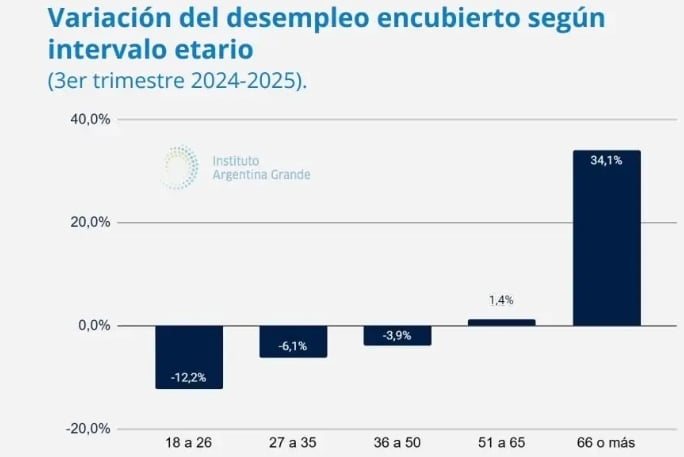
A report from the Instituto Argentina Grande (IAG), based on microdata from INDEC, quantified this trend, contradicting the “libertarian” view of the labor market. According to the study, in the third quarter of 2025, the labor activity rate among people older than 66 increased by 11% year-over-year. Experts describe this behavior as a “survival-type” search for income.
This phrase encapsulates the fact that this labor re-entry does not stem from personal choice or a voluntary continuation of an active life but from the urgent need to supplement incomes that have become insufficient to meet basic needs. The IAG report asserts that this phenomenon cannot be analyzed in isolation, as it simultaneously identified a year-over-year increase of 34. 1 percent in so-called “hidden unemployment”—which includes those with few hours of work, unstable employment, or low-quality jobs actively seeking more employment—surging particularly among those older than 66.
The Statistics of Insecurity The trend of retirees returning to work is part of a broader transformation in the Argentine labor market, where the line between being employed and unemployed has become blurred. The IAG report suggests that while the official open unemployment rate was 6. 6% in the third quarter of 2025, that number rises to 13.
8% when including forms of inadequate or precarious labor insertion. In its conclusions, the study issued a methodological warning that calls into question the reliability of the data released by Milei’s government: «the unemployment rate becomes an insufficient indicator of the pressure on the labor market. » To describe this reality, the report coins the term “blue unemployment,” referring to workers who, although formally employed, cannot generate sufficient income or achieve the necessary stability.
This “blue unemployment,” the study adds, is “primarily driven by older adults. ” This statistical redefinition assumes alarming proportions when linked to the evolution of pension incomes. By the end of 2025, the minimum pension was set at 340,879 pesos (Argentinian), an amount to which Milei’s government adds a bonus of 70,000 pesos, which has notably remained frozen since March 2024.
Thus, the total income for millions of Argentinians receiving the minimum pension closed the year at 410,879 pesos. However, this assistance, far from alleviating the situation, has lost real weight in an inflationary context that the government claims to have under control. With a cumulative price increase of 31.
5% in 2025, the purchasing power of the minimum pension dropped by 4. 6% year-over-year, as reported by El Destape. This deterioration cannot solely be explained by changes in the pension amount but also by the dynamics of the bonus that is given as a supplement.
According to available data, it registered a 23% real decline in 2025 and has accumulated a 46% loss since its last adjustment. To have maintained its original purchasing power, the bonus would have needed to reach 129,943 pesos in December, almost double the 70,000 that was actually granted. The consequence is direct and impacts a critical mass of the population: nearly 3 million retirees, representing 49.
2 percent of the total, have seen their incomes eroded in real terms. In this context of systematic loss, seeking informal work ceases to be an option and becomes an obligation resulting from the insecurity that older adults have fallen into. From the ‘Additional Worker’ to New Precarization Economic analysts often refer to the phenomenon of the “additional worker” during recessions, talking about young people who stop studying to work and add income to the household.
However, when income declines are frequent, deep, and combine with sustained losses in the purchasing power of pensions, a different phenomenon emerges: ‘additional work’ among older adults. The notion of ‘additional worker’ applied to this age group introduces a qualitative change, as it was previously associated with young people, but now shifts to those who have completed their work cycle and were supposed to enjoy well-deserved rest. This forced extension of active life does not, however, translate into formal or stable jobs that allow for accumulating additional years of contributions.
Instead, it channels mostly into low-productivity activities, with little or no social protection and high informality. These jobs suffice to alter a person’s statistical classification—from “inactive” to “employed”—but fail to resolve the chronic income insufficiency that initially motivated their labor reinsertion. INDEC’s methodology contributes to this distortion, as according to its official criteria, a person is considered employed if they worked at least one hour in the reference week, regardless of the quality, stability, or remuneration of that activity.
According to El Destape, the IAG report echoes this point noting that “unemployed individuals are those who did not work even one hour in the week prior to being surveyed by the official organization. ” “However, the dynamics of ‘self-employment’ results in many low-quality, part-time jobs, leading to many individuals not being identified as ‘unemployed’,” it adds. The outcome is an official picture that underestimates the real pressure on the labor market.
The expansion of low-hour, low-wage jobs does not reduce the need for employment but redistributes it in more fragmented and less visible forms. In this framework, retirees returning to work occupy a unique place: their presence increases the overall activity rate, but also feeds into the realm of underemployment and precarious jobs. Official data at the end of 2025 reflect this situation, albeit with numbers that downplay its impact.
While the general unemployment rate was recorded at 7. 5% of the economically active population, the share of men over 65 who were employed reached 3. 1%, and 2% for women.
Simultaneously, open unemployment in this age segment remains at low levels (1. 7% for men and 0. 9% for women), reinforcing the idea that the issue does not manifest in terms of classic unemployment but rather in weak, precarious, and, in many cases, undignified labor insertions.
Retirees Forced to Take Precarious Jobs to Support Their Income The relationship among these indicators helps illuminate why traditional measurement systems are so inadequate. Low unemployment among older adults coexists with a sustained increase in their labor participation and an explosive growth of hidden unemployment. In other words, fewer retirees appear as unemployed in the statistics, but many more are compelled to accept precarious or insufficient jobs to sustain their incomes.
Under this scenario, retirees returning to work is not an anecdotal data point in Argentina, but a reflection of the ever-deepening imbalance between incomes and the cost of living, between promised pension coverage and the real conditions of subsistence. According to the cited outlet, “the expansion of informal employment among older adults, far from alleviating pressure on the labor market, displaces it into less visible areas, where traditional statistical categories lose all explanatory capability,” and where the image of a grandparent working to eat dismantles, time and again, any triumphalist narrative from the Milei administration.
¿Te pareció importante esta noticia?
Compártela y mantén informado a Chile