ARMETRASE Calls for Action Against Normalization of Aggressions Following Violent Assault on Staff Member
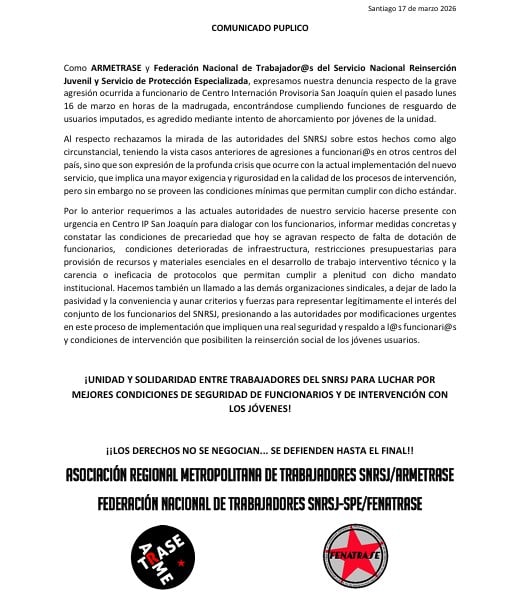
Original article: ARMETRASE exige frenar la normalización de agresiones tras violento intento de asfixia a funcionario Gonzalo Marín, leader of ARMETRASE, reported the precarious conditions at the San Joaquín Internment Center and criticized the service for pressuring staff to return to work without proper physical and mental recovery. In the early hours of Monday, March 16, a staff member at the San Joaquín Internment Center (CIP) was seriously assaulted when a group of youths ambushed him after he went to the restroom. One of the inmates attempted to choke him with an «arm lock» while another attacked him with shoelaces, in an incident that the Regional Metropolitan Association of Sename Workers (ARMETRASE) describes as an extremely grave situation for staff safety.
Gonzalo Marín, president of ARMETRASE, criticized the institutional management for lacking effective preventive measures. The leader stated that «it appears the service intends to normalize this situation,» warning that violence should not be seen as «something that is expected to happen,» emphasizing the need for an interventionist approach in handling such matters. Marín criticized how these issues are largely overlooked by the Service, due to the precarious operational conditions.
He explained that there is currently a staff shortage of around 50%, which, combined with a «lack of preventive protocols,» creates an environment that fosters violent incidents against both workers and the youth. A critical issue is the lack of post-traumatic protection and the pressure to return to work after attacks. Marín reported that the contracted mutuality often pushes staff members to quickly resume their positions “without full recovery,” ignoring that the healing process can be slow, affecting both physical health and mental well-being that are not addressed urgently.
This situation is reportedly occurring in centers across Chile. The crisis at the San Joaquín center is exacerbated by its uncertain future, with its transition to Álamos 3 and 4 as a memory site. This instability, combined with budget cuts from Kast’s administration under an «emergency government,» leads to a technical abandonment that leaves both staff and youths in absolute insecurity without investment in safety.
For Marín, it is a painful irony that a place meant to preserve historical memory regarding human rights violations has become a site for new abuses. In this location, cycles of state violence are repeated, affecting «both staff and those receiving care,» under an administration that has failed to address the system’s previous shortcomings. National and regional leadership has been called upon by workers to take action and prevent the normalization of these situations.
In light of inadequate responses, the center is preparing to expose the poor management and demand conditions that ensure the safety of both staff and the youth.
¿Te pareció importante esta noticia?
Compártela y mantén informado a Chile